Picking a vendor is harder than it looks. "Warehouse robotics company" now covers AMR makers, storage and retrieval providers, picking specialists, fleet-software developers, and turnkey integrators. They are not direct substitutes.
This article compares five providers (IPLUSMOBOT, Dematic, Symbotic, Locus Robotics, and Geek+) on technology fit, integration, deployment model, industry experience, scalability, and lifecycle support.
Key Takeaways
- Some vendors sell individual AMRs; others deliver full storage, sortation, and software systems.
- The right pick depends on your main need: pallet moves, goods-to-person picking, dense storage, or full DC automation.
- Check WMS/WES/ERP integration, safety certification, facility changes, and total cost of ownership.
- IPLUSMOBOT offers AMRs, forklift AMRs, and fleet software; confirm US deployment and support details.
Overview of Warehouse Robotics in the US Market
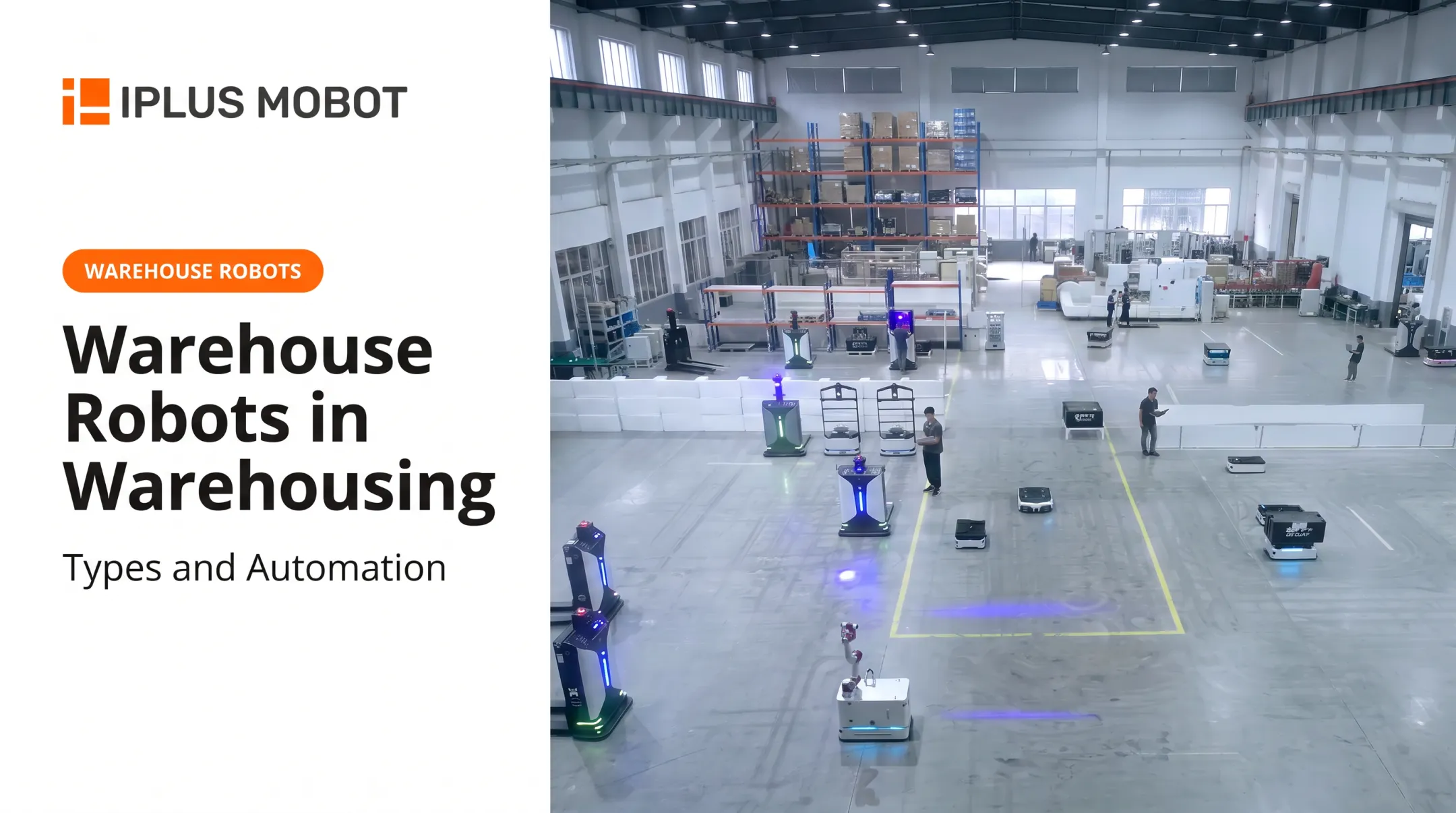
Warehouse robotics combines physical systems with the software that coordinates them. The hardware includes AMRs, AGVs, forklift robots, robotic arms, sortation robots, and AS/RS equipment. The software assigns tasks and tracks inventory, people, and other automation.
Demand comes from retail, e-commerce, 3PL, automotive, electronics, pharmaceutical, and distribution operations. E-commerce reached 17.1% of retail sales in Q2 2026, according to the Census Bureau. In a 2026 survey of 166 industry subscribers, 52% reported using at least one robot type. That is a survey indicator, not a national adoption rate.
Four vendor types you will meet
- Robotics manufacturer: builds the robots, such as AMRs or forklift AMRs.
- Systems integrator: connects robots, conveyors, controls, and software into one working site.
- Warehouse execution software provider: directs people and machines in real time, sitting between the WMS plan and the floor.
- Turnkey automation vendor: delivers engineering, equipment, software, and service as a package.
Mobile robots often make up under 25% of a system integrator's project, but 25-75% of a solutions vendor's. Compare scope, not logos. The five companies below sit in different categories, so judge them by operational fit.
Top Warehouse Robotics Companies for US Warehouses
Selection criteria for this list:
- Relevance to warehouse and intralogistics work
- Technology maturity and product breadth
- Integration capability and implementation evidence
- Global delivery and suitability for US buyers
Much of the evidence below is vendor-reported, and it is labeled that way.
IPLUSMOBOT
Founded in 2016 in Hangzhou, IPLUSMOBOT grew from an AMR developer into a provider of mobile robots, fleet software, and smart intralogistics systems.
Its range includes standard AMRs such as the EMMA series, pallet-handling forklift AMRs (FOLA, BN, DN), and OMNI omnidirectional AMRs, plus CLOUDIA and CARLY fleet software and OWL warehouse software.
What stands out:
- Self-developed core technology and fleet software
- Full-stack offering, from standalone robots to plant-wide deployments
- Partnerships with more than 500 manufacturers
- ISO 9001:2005 and CE certifications
- A wholly owned US subsidiary established in 2025
Its largest-market-share ranking in China's industrial logistics AMR sector applies to China only. It is not evidence of US market leadership.
| Dimension | Summary |
|---|---|
| Primary specialization | AMRs, forklift AMRs (such as the 2,000 kg FOLA BN2001), fleet management coordinating 100+ robots, and warehouse software with WMS/ERP integration |
| Integration and deployment questions | Ask about WMS/WES/ERP interfaces, fleet scale, facility requirements, who handles implementation, US support arrangements, and applicable US safety and electrical certifications |
| Best fit | Pallet transport, replenishment, line-side delivery, inter-plant movement, and warehouse automation; buyers may need a third-party integrator |
Its stated US route to market runs largely through regional automation integrators. Current US deployment details should be confirmed directly.
Dematic
Dematic is part of KION Group's Supply Chain Solutions segment. KION's annual report describes standalone and end-to-end solutions: AGVs, storage and picking equipment, conveyors, sorters, and proprietary software.
It stands out on large, complex projects. Dematic's Anheuser-Busch case study reports an AS/RS with capacity for 12,936 pallets and 40 AGVs. That is a vendor-reported project detail, not an independent benchmark.
| Dimension | Summary |
|---|---|
| Primary specialization | Distribution-center automation: AS/RS, Multishuttle, conveyors, sortation, AGVs, and WMS/WES/WCS software |
| Integration and deployment model | Turnkey provider and integrator; clarify WMS, WES, controls, and third-party equipment boundaries and responsibilities up front |
| Best fit | Large, high-throughput, complex facilities, greenfield or brownfield, where an end-to-end integrator beats a standalone AMR supplier |
Symbotic
Symbotic sells an integrated system for pallet, case, and each handling. It combines robotic depalletizing, lifts, mobile robots, storage, and palletizing under proprietary AI software.
SEC filings identify Walmart and C&S Wholesale Grocers as operational customers. The company reported a backlog of about $22.5 billion as of June 27, 2026, largely Walmart and Exol. It acquired Walmart's Advanced Systems and Robotics business for $200 million in January 2025.
| Dimension | Summary |
|---|---|
| Primary specialization | High-density storage, retrieval, case and pallet handling, with a coordinated robot fleet |
| Integration and facility requirements | Expect building design, infrastructure, WMS/WES integration, commissioning, and maintenance planning; best suited to greenfield or major brownfield projects |
| Best fit | High-volume retailers, grocers, and wholesale networks; a poor match if you want incremental, modular AMR rollout |

Locus Robotics
Locus provides collaborative AMRs for picking and tote movement, orchestrated by LocusONE software. Its product page lists Origin, Vector, and Array robots. Locus reported passing 7 billion cumulative picks in March 2026, which is vendor-reported. A DHL pilot in Tennessee confirms a US example, though performance was not independently validated.
Its Robots-as-a-Service model is an annual subscription covering robots, software, service, and support, plus a one-time site setup fee. No price is published.
| Dimension | Summary |
|---|---|
| Primary specialization | Worker-assisted picking, tote movement, and order fulfillment in existing facilities |
| Integration and commercial model | Ask about WMS integration, site mapping, charging, training, and whether purchase, lease, or RaaS applies |
| Best fit | US e-commerce, retail, healthcare, and 3PL sites that want to cut walking and add picking capacity without fixed infrastructure |
Geek+
Geek+ offers shelf-to-person (P-series), tote-to-person (RoboShuttle), pallet-to-person (SkyCube), sorting (FleetSort), and forklift solutions. Its 2026 results announcement reports over 72,000 robots shipped to 40+ countries and about 950 end customers, all vendor-reported. A 2024 release cites 75+ North American projects, including a Körber-partnered Illinois site with 340 robots.
Global counts do not prove US service coverage, and partner deployments do not blur the line between OEM and integrator.
| Dimension | Summary |
|---|---|
| Primary specialization | Goods-to-person, sortation, storage, replenishment, and pallet movement |
| Integration and deployment questions | Examine WMS/WES connectivity, integrator relationships, facility modifications, cybersecurity, service response, and spare parts |
| Best fit | Order-heavy operations that benefit from goods-to-person or dense mobile storage; look elsewhere for simple pallet transport |
How We Chose the Best Warehouse Robotics Companies
Strong shortlists rest on technical fit, lifecycle support, and total cost of ownership, not brand size. Avoid these common selection mistakes:
- Ranking by revenue or funding alone
- Comparing an AMR manufacturer with a turnkey integrator
- Accepting vendor-reported performance without context
- Ignoring software and service dependencies
Technical and lifecycle fit
On the technical side, evaluate:
- Payload capacity and physical dimensions
- Navigation method and obstacle avoidance
- Fleet orchestration and system integration
- Operating environment, cybersecurity, and uptime
- Peak-demand handling under real workloads
Hardware alone is not enough. On the lifecycle side, ask about:
- Facility changes and deployment timeline
- Training, maintenance, and spare parts
- Phased rollout options
Brownfield sites can need small but real changes, such as moving a shelf for a charging station or shifting pallet racks about 8 inches to meet safety rules.
Safety standards matter in the US. Relevant titles include ANSI/A3 R15.08, ANSI/ITSDF B56.5-2024, ANSI/CAN/UL 3100:2026, and UL 1740. These do not prove a given robot is compliant. Verify the exact system and edition with qualified specialists.

Total cost of ownership
Robot price is one line item. Build the full picture with:
- Software, integration, and infrastructure
- Installation, charging, and maintenance
- Labor changes and financing or RaaS terms
McKinsey's analysis notes that broader scope can raise costs, timelines, and payback periods, and that projects fail from weak vision and misalignment. It recommends integration, testing, and piloting before scaling.
L.E.K. reports over 80% of operators see payback under two years. Treat that as a benchmark, not a promise.

Conclusion
The strongest provider matches your workflow, facility, throughput, labor model, integration environment, and growth plan. Valuation and robot count are poor proxies.
Before a full rollout:
- Compare at least two solution types
- Request comparable customer references
- Validate performance in a pilot or site assessment
- Calculate total cost of ownership
US warehouses, manufacturers, 3PLs, and automation integrators weighing pallet-moving AMRs can talk with IPLUSMOBOT about its AMRs, forklift AMRs, fleet software, and smart intralogistics capabilities. Confirm current US delivery, integration, and support options first; a US support hotline is listed at 1-833-999-9327.
Frequently Asked Questions
What is warehouse automation?
It is the use of software, equipment, robotics, and connected systems to automate storage, movement, picking, replenishment, sorting, packing, and inventory work. Robotics is one part; the software layer ties it together.
What robots are used in warehouses?
AMRs and AGVs move loads, autonomous forklifts handle pallets, and AS/RS robots store and retrieve. Robotic arms pick and pack, palletizers build loads, and sorting robots route parcels.
How much does it cost to automate a warehouse?
No universal price exists. Cost depends on facility size, task scope, robot type, software, integration, infrastructure, installation, maintenance, and commercial model. Equipment price is only part of total project cost.
What does an automation integrator do?
An integrator designs, connects, installs, tests, and supports multiple systems: robots, conveyors, storage, controls, and WMS, WES, and ERP interfaces. Scope varies by provider.
What is supply chain automation?
It is the broader use of digital systems, robotics, sensors, analytics, and workflow tools across procurement, manufacturing, warehousing, transportation, and fulfillment. Warehouse robotics is one piece of it.