US manufacturers are looking at all of it. The US installed 38,400 industrial robots in 2025, up 12% year over year, according to the IFR's 2026 release. The goals vary: repeatability, material flow, worker safety, labor resilience, and flexibility. The right system depends on the task and the environment.
This guide defines industrial robotics, compares the major robot types, walks through real applications, and covers benefits, safety, integration, and autonomy.
Key Takeaways
- Industrial robots are programmable systems, but results depend on controllers, sensors, tooling, and integration.
- Welding, machine tending, inspection, palletizing, and transport each need different robot configurations.
- Fixed arms, cobots, AGVs, and AMRs are not interchangeable.
- Safety engineering, training, maintenance, and total cost of ownership matter more than purchase price.
What Are Industrial Robots?
Definition and Core Components
ISO 8373:2021, as summarized by the IFR, defines an industrial robot as an automatically controlled, reprogrammable, multipurpose manipulator programmable in three or more axes. It can be fixed in place or mounted on a mobile platform.
In practice, a working robot system includes:
- The manipulator or mobile base
- A controller and drive system
- An end effector, such as a gripper or welding torch
- Sensors and vision equipment
- Safety devices
- Application software
How Industrial Robots Operate
The cycle is simple. The robot receives a program or task, senses the work area, moves through defined coordinates, completes the task, and reports status or exceptions.
Two modes matter. Pure programmed motion is highly repeatable but assumes parts show up in the same place. Sensor-guided operation uses vision, force sensing, or lidar to respond to part position, product variation, or obstacles.
Industrial Robots Versus Related Automation
| Type | Mobility | Navigation | Best for |
|---|---|---|---|
| Fixed industrial robot | Stationary | Programmed coordinates | Welding, painting, assembly |
| Cobot | Usually stationary | Programmed, force-limited | Shared workspaces, light tasks |
| AGV | Mobile | Predefined path (tape, markers) | Predictable, repeated routes |
| AMR | Mobile | Maps and sensors, dynamic | Changing layouts, mixed traffic |
Conveyors work well for high-volume flows with fixed destinations, but they are hard to move or reprogram. A robot is rarely standalone. It sits inside a workcell or intralogistics system tied to PLCs, conveyors, MES, WMS, and fleet software.
How Are Industrial Robots Used in Manufacturing and Industry?
Fixed-Arm Manufacturing Processes
Welding, painting, coating, cutting, dispensing, deburring, and polishing reward repeatable motion and controlled tool paths. Quality across different parts depends less on the arm than on end effectors, fixtures, vision, and process monitoring.
Handling dominates globally. Statista's 2025 estimate puts handling at 51% of installed stock in 2024, welding at 15%, and assembly at 10%.

Assembly, Machine Tending, and Quality Control
Robots load and unload CNC machines, presses, and injection molding equipment. That removes repetitive handling and keeps cycle times steady. Ohio fabricator Raymath reported production gains of 200% in welding and 600% in CNC tending after adding cobots, per an IFR case study. That is one company's result, not a benchmark.
For assembly and inspection, cameras and force sensing support defect detection, barcode or serial-number reading, and traceability.
Material Handling and Intralogistics
Pick-and-place, packaging, palletizing, depalletizing, line-side delivery, and work-in-process transport all fall here. Mobile robots increasingly link production cells, warehouses, and shipping.
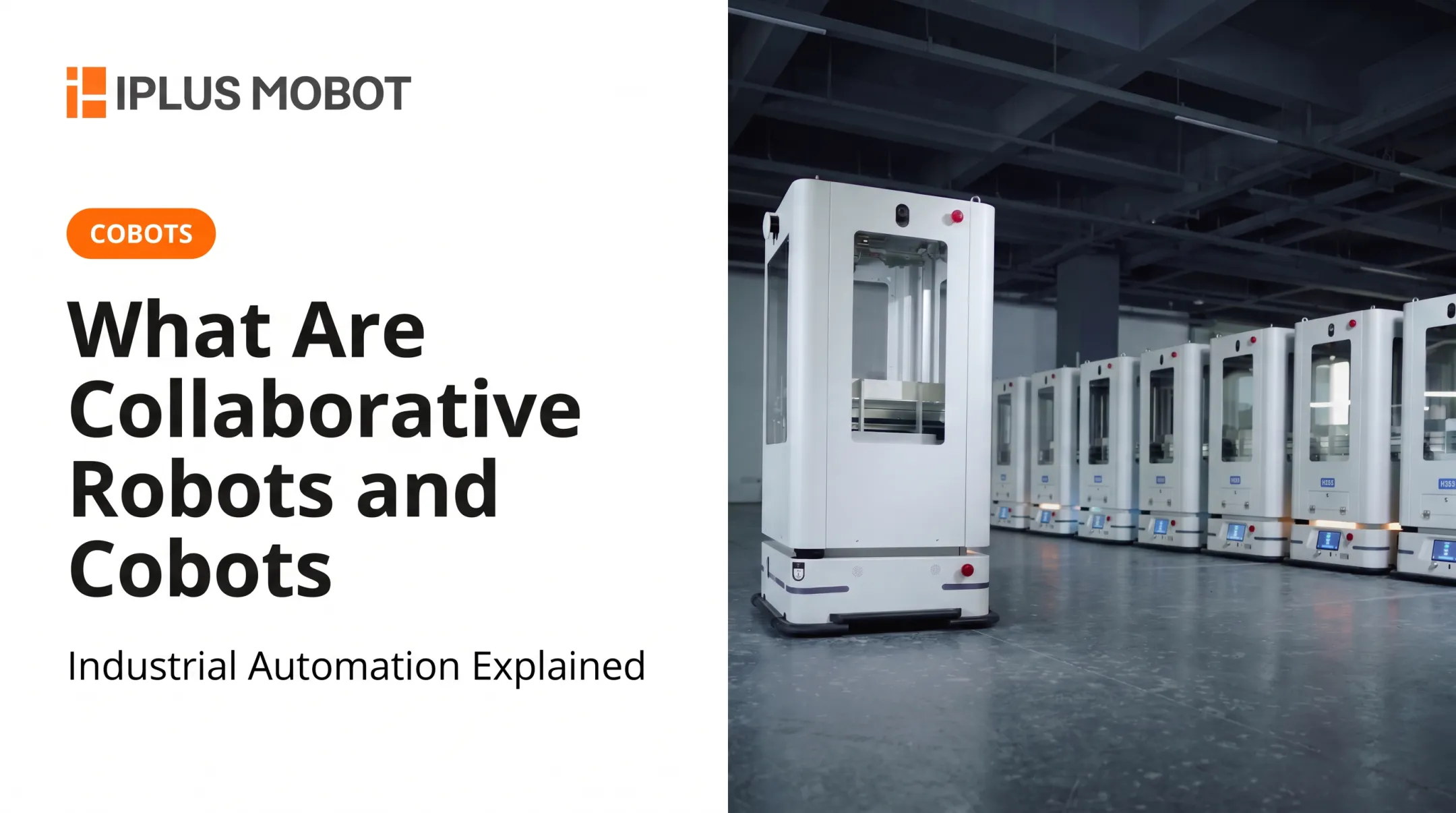
IPLUSMOBOT is one provider in this space, offering AMRs, CLOUDIA fleet management software, and intralogistics solutions. Its models range from standard AMRs to forklift units; the EMMA 600K, for instance, carries 600 kg. In one clean LCD workshop, more than 100 AMRs ran under CLOUDIA with ±2 mm handling precision.
Suitability still depends on site mapping, payload, traffic, floor conditions, safety, and integration. Ask any vendor for site-specific validation.
Industry-Specific Use Cases
- Automotive and EV: line-side part delivery, heavy pallet moves, welding
- Electronics and SMT/PCBA: small, fragile, high-value WIP with tight cycle times
- Display and cleanroom: precise, contamination-sensitive transport
- Metalworking: machine tending, welding
- Food and beverage: palletizing, high-speed packaging
- Warehouses and 3PL: put-away, replenishment, goods-to-person picking
In the US, automotive remains the largest customer industry with 13,500 installations in 2025 (down 1%). Metal and machinery fell 15% to 3,000, while food and beverage rose 30% to 2,900. Electronics and pharmaceutical installations were not broken out in the same figures, so one ranking does not fit every US segment.

Main Types of Industrial Robots
Robot classification varies by source. The International Federation of Robotics (IFR) groups industrial robots by kinematic type; those categories are common reference points, not an exclusive list.
Articulated Robots
Multi-joint arms with three or more rotary joints offer a wide range of motion. They handle welding, assembly, machine tending, painting, and palletizing.
Key selection factors:
- Payload and reach
- Number of axes
- Repeatability
- Mounting position and work envelope
- Tooling and cycle time
SCARA Robots
SCARA arms have two parallel rotary joints, giving compliance in a horizontal plane. They are fast and stiff, suited to bench-height assembly, screwdriving, dispensing, and small-part electronics work. The limited envelope makes them a poor fit for large or complex 3D movements.
Cartesian, Cylindrical, and Polar Robots
Cartesian robots move along three linear axes. Cylindrical designs combine one rotary and two linear axes; polar designs use a twisting base with a mix of linear and rotary joints. They still earn a place in machine loading, packaging, and material handling where a simple, defined envelope matters more than flexibility.
Delta or Parallel Robots
Delta robots hang overhead on parallel arms and excel at high-speed pick-and-place of light products in food, pharmaceutical, and packaging lines.
Plan around these limits:
- Payload capacity
- Product presentation and conveyor speed
- Vision alignment
- Sanitation needs and specialized grippers
Collaborative Robots
Cobots use force limits, speed monitoring, and sensing to work closer to people. Collaboration is not a separate geometry. ISO/TS 15066 covers the whole collaborative system and its work environment.
A cobot label does not make an application safe. The end effector, payload, workpiece, fixtures, nearby machinery, and procedures all need a documented risk assessment.
Mobile Industrial Robots
AGVs follow predefined paths. AMRs use maps, sensors, and software to navigate dynamically. Terminology is inconsistent across the industry, so confirm what a vendor means.
When selecting a mobile robot, compare:
- Payload and lift or tow method
- Navigation accuracy
- Traffic management and fleet orchestration
- Floor quality, charging, and connectivity
- Human interaction and outdoor capability
Benefits and Business Impact of Industrial Robotics
Productivity, Consistency, and Quality
Robots repeat precision-critical work with steady timing. FANUC reports a Swivellink machine-tending cell that raised production efficiency 33%, with a 33-week ROI. That result is vendor-reported and case-specific.
The bigger payoff often comes from the data robots generate. Inspection and process data support traceability, root-cause analysis, and continuous improvement beyond a standalone machine purchase.
Safety, Labor Resilience, and Cost Management
Robots can take over heavy lifting, hot, hazardous, or ergonomically punishing tasks. They also create new risks in programming, maintenance, and interaction.
Total cost of ownership should include:
- Integration and tooling
- Guarding and safety systems
- Software and training
- Maintenance and energy
- Downtime and future reprogramming
Commercial models differ as well. Capex means upfront payment with separate maintenance, while rental typically runs 3–5 years at a set monthly fee with maintenance included. No generic payback figure applies across applications, so model your own.
Data, Flexibility, and Workforce Development
Connected robots feed production monitoring, predictive maintenance, and inventory tracking when linked to the right systems.
Roles shift toward supervision, programming, maintenance, and exception management. A NIST MEP case at Poly-Tech found employees needed training in cobot programming, quality checks, and routine maintenance. Deloitte's 2025 survey found 48% of manufacturers had difficulty filling production and operations-management roles.

Safety, Integration, and Future Readiness
Application-Level Safety
Risk exists beyond normal operation: installation, programming, changeovers, cleaning, maintenance, jam removal, and fault recovery.
Key US references:
- ANSI/A3 R15.06-2025: adopts ISO 10218-1 and -2:2025 for robots and cells
- ISO/TS 15066: collaborative systems
- ANSI/A3 R15.08 (Parts 1–3): industrial mobile robots; Part 3 published April 2026
- ANSI/ITSDF B56.5 (2024): driverless industrial vehicles
- OSHA: no robot-specific standard, but 29 CFR 1910.147 (lockout/tagout) and 1910.212 (machine guarding) apply
- NIOSH: Center for Occupational Robotics Research
Effective programs address risk assessment, guarding, interlocks, emergency stops, lockout/tagout, and mobile robot traffic rules.
Deployment and Integration Roadmap
- Identify a measurable bottleneck.
- Collect process data.
- Assess task suitability.
- Select the robot and tooling.
- Design the cell or route.
- Simulate and test.
- Integrate controls and software.
- Commission safely.
- Train operators.
- Monitor performance.

Integrators often connect robots to fixtures, conveyors, machines, WMS or MES platforms, fleet software, and safety systems. A3 runs a Certified Robot Integrator program, which includes an on-site audit.
Autonomy, AI, and Connected Robotics
Autonomy can mean navigation, perception, task execution, fleet coordination, or exception handling. Most systems still need human supervision.
Current examples are task-specific. A Danfoss cell uses 3D vision to handle up to 100 components without manual intervention. Siemens describes analyzing robot-axis torque trends to flag a possible grease leak. Fully autonomous general-purpose factory operation is not standard.
Interoperability is improving. VDA 5050 v3.0 (2026) offers an open interface between mobile robots and fleet control, and ISO 21423:2026 covers information exchange among mobile robots and fleet managers.
Future-Readiness for US Manufacturers
Reshoring, labor constraints, product variation, and cybersecurity will shape buying decisions. The Reshoring Initiative reported 244,000 US manufacturing jobs announced in 2024 through reshoring and foreign direct investment, though announcements are not filled jobs.
Connected robots also expand the OT attack surface, so include NIST SP 800-82 Rev. 3 and ISA/IEC 62443 in planning.
Before buying, work through this checklist:
- Define the task and the success metric
- Map human-machine interaction
- Estimate full lifecycle cost
- Validate safety
- Choose technology that scales with future products
Frequently Asked Questions
How are robots being used in manufacturing?
Common uses include welding, assembly, machine tending, inspection, packaging, palletizing, and material transport. Fixed robots handle processing at a station; mobile robots move materials between stations.
Who are the top 5 industrial robot manufacturers?
Statista's 2023 global market share snapshot lists ABB, Epson, FANUC, Kawasaki, and Yaskawa, with ABB/Epson and Kawasaki/Yaskawa tied. It is a global snapshot, not a regional or current arms-only ranking.
What industry uses industrial robots the most?
In the US, automotive led 2025 installations with 13,500 units, per IFR. That reflects annual installations, not operational stock or robot density.
Are there any fully autonomous robots?
Autonomy exists in navigation, perception, transport, and specific tasks. Most deployments still rely on humans for exceptions, maintenance, safety, and process decisions.
What are the five main types of industrial robots?
A common list is articulated, SCARA, Cartesian, cylindrical, and delta. Others add polar, collaborative, and mobile robots. Taxonomies vary.
What is industrial robotics?
It is the application of programmable robotic systems to manufacturing, material handling, inspection, processing, logistics, and related industrial tasks.