Introduction
US warehouses are squeezed from several directions at once. Labor is hard to hold onto, order profiles keep getting messier, and space costs more every year. In Cushman & Wakefield's Q2 2026 data, industrial vacancy sat at just 6.9%.
E-commerce adds pressure. The Census Bureau reports US e-commerce sales of $329.5 billion in Q2 2026, up 12.2% year over year.
Warehouse automation answers that pressure with software, data capture, material-handling equipment, and robotics that cut repetitive manual work in moving and managing goods. This guide covers the main system types, the processes you can automate, current trends, and a framework for choosing a path.
Key Takeaways
- Automation is layered: start with data capture and software, then add conveyors, AS/RS, or mobile robots.
- SKU profile, order mix, layout, load weight, and throughput decide the right technology.
- Fixed systems deliver steady volume; flexible systems such as AMRs adapt to change.
- Watch AI orchestration, interoperability, safer human-robot work, RaaS, and predictive maintenance.
What Is Warehouse Automation and How Does It Work?
Warehouse automation rarely means full autonomy. Most successful warehouses pair people with digital tools, mechanized equipment, and robots. People still handle exceptions, supervision, maintenance, quality control, and decisions.
Digital and physical layers
Digital automation covers the warehouse management system (WMS), warehouse execution system (WES), enterprise resource planning (ERP) links, barcode scanning, RFID, task assignment, and analytics. MHI describes the WMS as creating work plans and the WES as directing people and machines in real time.
Physical automation moves or handles goods:
- Conveyors and sorters
- Automated storage and retrieval systems (AS/RS)
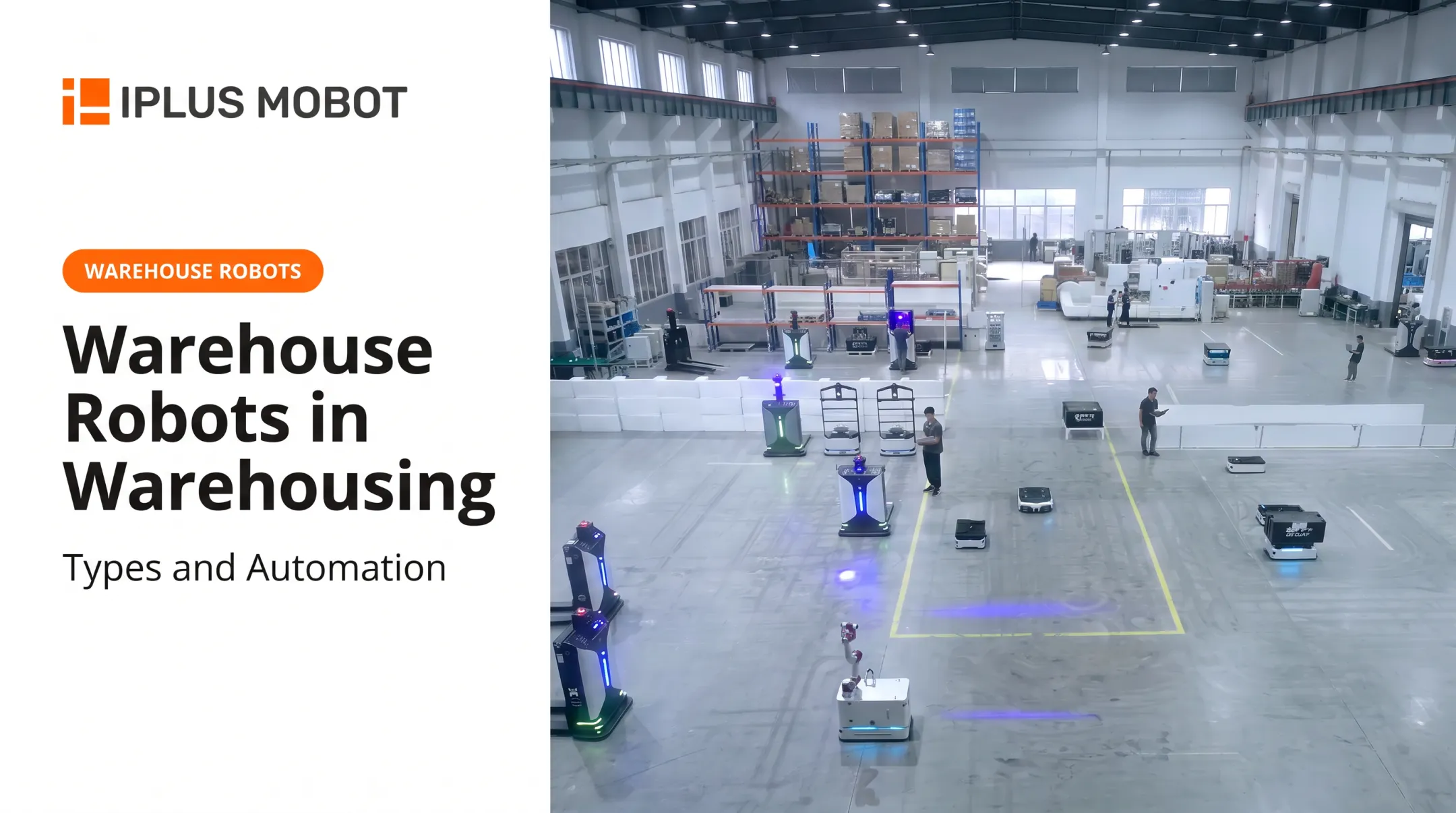
- Automated guided vehicles (AGVs) and autonomous mobile robots (AMRs)
- Autonomous forklifts
- Robotic arms and automated packing equipment
A representative workflow
- Receiving and identification: scans capture goods and update inventory records.
- Put-away and storage: the system assigns a location; a forklift AMR or conveyor moves the load.
- Replenishment and picking: software releases tasks; goods-to-person systems or mobile robots cut walking.
- Packing, sortation, and shipping: scales, dimensioning, and label printers verify and route orders.
- Returns: scans trigger restocking or disposition.
Data connects every step. Inaccurate records at receiving will undermine even the best robots downstream.

Automation tends to progress in stages, from basic digital tools to mechanized systems to advanced robotics. No industry standard defines those levels, so treat any vendor's "levels" as a planning aid, not a rulebook.
Types of Warehouse Automation Systems
Digital and system automation
Digital tools automate instructions, identification, and inventory updates. Common options include:
- WMS, WES, and fleet-management platforms
- Barcode and RFID identification
- Voice picking, pick-to-light, and put-to-light
- Wearables for hands-free task guidance
They address inaccurate records, wasteful travel paths, manual task assignment, and poor visibility.
They do not replace physical automation in every case. A 2025 controlled study in Sensors found pick-by-light fastest among paper, light, and point methods, though it was a limited lab setting, not a warehouse benchmark.
Fixed material movement and sortation
Conveyors, lifts, sorters, scanners, scales, dimensioners, and automated packing stations give consistent flow at high volume. The tradeoff is layout rigidity. Changing a conveyor line when demand shifts is slow and costly, which is why fixed systems suit predictable volume.
Goods-to-person systems and AS/RS
Goods-to-person (GTP) systems bring totes, trays, or pallets to a worker, eliminating walking between picks. Common AS/RS types:
| Type | Typical fit |
|---|---|
| Unit-load | Palletized loads of 1,000 lb or more; racks can exceed 100 ft |
| Mini-load | Loads of 1,000 lb or less in totes, trays, or cartons |
| Pallet shuttle | Dense pallet storage with vehicles per level |
| Vertical lift module | Small, fast-moving parts and tooling |
| Vertical carousel | Rotating shelves; generally shorter than VLMs |
Selection depends on:
- Ceiling height and storage density
- SKU dimensions, weight, and order frequency
- Temperature control and replenishment needs
- WMS/WES integration
These figures are category descriptions, so confirm specifications with the vendor.
AGVs, AMRs, and autonomous forklifts
AGVs follow predetermined paths such as tape, wire, or reflectors. A3 describes AMRs as using onboard sensing and dynamic navigation to adapt to obstacles. Autonomous forklifts extend this to pallets and heavier loads.
IPLUSMOBOT builds this class of equipment: standard AMRs, forklift AMRs, and CLOUDIA and CARLY fleet software. Its FOLA BN2001 forklift AMR carries rated payloads up to about 4,400 lb (2,000 kg). Its forklift AMRs use SLAM navigation and AI pallet detection to support flexible warehouse and manufacturing material movement.
Robotic picking, packing, and palletizing
Robotic arms, cobots, and machine vision handle picking, depalletizing, palletizing, and packing. Suitability hinges on product variability, gripping, safety, and exception handling. Mixed, irregular, or fragile items remain the hard cases.
Specialized and emerging tools
Drones, inventory-scanning robots, computer vision, IoT sensors, and automated cleaning each solve narrow problems. Evaluate each against a defined task rather than novelty alone.

Which Warehouse Processes Can Be Automated?
Nearly every warehouse stage has an automation option:
| Process | Technology | Objective |
|---|---|---|
| Receiving, identification | Scanners, RFID, WMS | Location accuracy |
| Put-away, internal transport | AMRs, forklift AMRs, conveyors | Less manual handling |
| Storage, replenishment | AS/RS, GTP | Density, less travel |
| Cycle counting | RFID, scanning robots, drones | Record accuracy |
| Picking | GTP, mobile robots, light/voice | Throughput, accuracy |
| Packing, sortation | Scales, vision, auto-labeling | Traceability |
| Staging, loading, shipping | Conveyors, forklift AMRs | Faster dock turns |
| Cross-docking, returns | Sorters, scanning | Speed, routing |
Picking deserves priority. MHI cites industry averages putting picking at more than 50% of warehouse labor budgets.

Picking and packing automation
GTP and mobile robots cut travel time. Supporting tools lock in accuracy and traceability:
- Scanners and vision systems
- Pick-to-light and voice picking
- Weighing, dimensioning, and automated labeling
Use cases
- 3PLs and distribution centers: GEODIS deployed 12 Locus AMRs across a 40,000 sq. ft. picking area. Treat it as a deployment example, not a transferable benchmark.
- Automotive and EV plants: AMRs deliver parts line-side and move heavy pallets between stamping, welding, and assembly. A Tier 1 supplier case used six MiR250 robots to carry material from warehouse to line.
- Electronics and PCBA: AMRs move small, fragile, high-value WIP between production cells on tight cycle times.
- Inter-plant sites: Polar Semiconductor, a US chipmaker, uses seven robots to move material from main work-in-progress storage.
Warehouse Automation Trends to Watch
AI, machine learning, and computer vision
AI supports forecasting, slotting, route planning, task prioritization, anomaly detection, robot perception, and predictive maintenance. In McKinsey's 2026 shipper survey, 96% of shippers had deployed at least one surveyed AI or digital warehousing use case, and 84% said warehouse tools met or exceeded expectations.
Interoperable fleets and orchestration
Buyers increasingly want software that coordinates multiple robot types, WMS/WES data, human tasks, charging, traffic, and exceptions. Interact Analysis found buyers use an average of 3.4 mobile-robot brands, so mixed fleets are normal.
Standards help: VDA 5050 covers robot-to-master-control communication, the MassRobotics standard shares robot status data, and ISO 21423:2026 addresses communications and interoperability. Pair them with open APIs and OT security guidance such as NIST SP 800-82 Rev. 3, and settle data governance before adding vendors.
Human-robot collaboration and safety
Cobots, AMRs, autonomous forklifts, wearables, and safety sensors let people and machines share workflows. Require risk assessments, marked operating zones, training, and emergency procedures.
OSHA has no specific robotics standards. Consensus standards still guide practice: ISO 3691-4:2023, ANSI/A3 R15.08-2-2023, and ANSI/ITSDF B56.5-2024.
Modular automation, retrofits, and RaaS
Phased deployments, leasing, and subscriptions lower the entry barrier. In Modern Materials Handling's survey, 29% favored RaaS, though among current robot users only 11% did; 53% preferred hardware purchase plus software subscription.
The tradeoff:
- Lower upfront capital and easier scaling
- Recurring fees, long-term cost, service commitments, data access, and vendor dependence
Sustainability and predictive operations
Energy-efficient drives, shorter travel, less product damage, right-sized packaging, and equipment health monitoring all support efficiency goals. NREL estimates US warehouses use 0.43 quads of energy a year. That is sector context, not an automation savings figure. Interact Analysis found post-deployment pain points include missing maintenance prediction and costly downtime.

How to Choose and Implement Warehouse Automation
1. Assess readiness
Document the factors that shape fit and risk:
- Order volume and order-line profiles
- SKU sizes, weights, and inventory accuracy
- Labor-heavy tasks and current layout constraints
- Ceiling height, aisle widths, and floor condition
- Environment, safety limits, power, and network
- Existing WMS or ERP
2. Match problem to technology
- Visibility gaps: software and data capture
- Dense storage, repetitive retrieval: GTP or AS/RS
- Predictable high-volume flow: conveyors and sortation
- Flexible transport and pallets: AMRs or forklift AMRs
Forecasting matters. McKinsey describes a company whose facility plan used wrong inventory-turn and channel-mix forecasts, leaving advanced picking automation underused.
3. Evaluate integration and lifecycle support
Vet the full stack before you buy:
- WMS/WES/ERP connectivity and APIs
- Fleet compatibility and cybersecurity
- Maintenance, spare parts, and training
- The vendor’s ability to expand with you
Interact Analysis found vendor reputation and service mattered more than price.
4. Phase the rollout
- Set baseline KPIs.
- Clean and standardize data.
- Simulate or pilot one workflow.
- Train employees.
- Test safety and exception procedures.
- Monitor throughput and accuracy.
- Scale only when the pilot hits its targets.
MHI notes pilots can take months, so plan for it.

5. Build the ROI model
Model the full cost and return stack:
- Hardware, software, and integration
- Facility changes, training, and maintenance
- Energy, labor shifts, and downtime risk
- Error reduction and space gains
Payback varies by site and scope, so use project-specific numbers. MHI says the engineering analysis behind an ROI may take six to eight weeks.
Next step
Warehouse operators, manufacturers, and US integrators can compare IPLUSMOBOT's flexible AMRs, forklift AMRs, fleet software, and integrated intralogistics options against their own material-movement requirements. Contact sales@iplusmobot.com to start.
Frequently Asked Questions
What is logistics automation?
It applies software, data, equipment, and robotics to coordinate the movement, storage, tracking, and fulfillment of goods across warehouses and wider supply chains.
What are the different types of warehouse automation systems?
Digital automation, fixed material handling, AS/RS and goods-to-person, mobile robots, and robotic handling. Supporting tools include RFID, vision, voice, and light-directed picking.
What is an example of warehouse automation?
An AMR carries totes or pallets between storage and picking areas while the WMS updates inventory and assigns the next task.
How has automation changed picking and packing?
Goods-to-person systems and mobile robots cut travel. Scanners, vision, weighing, dimensioning, and automated labeling improve traceability and consistency.
How does warehouse logistics work?
Goods move from inbound receiving and identification through storage, replenishment, picking, packing, shipping, and returns. Connected data ties each step together.
How is AI used in logistics?
It supports forecasting, inventory positioning, route and task planning, computer vision, predictive maintenance, anomaly detection, and fleet orchestration. It needs accurate data and human oversight.