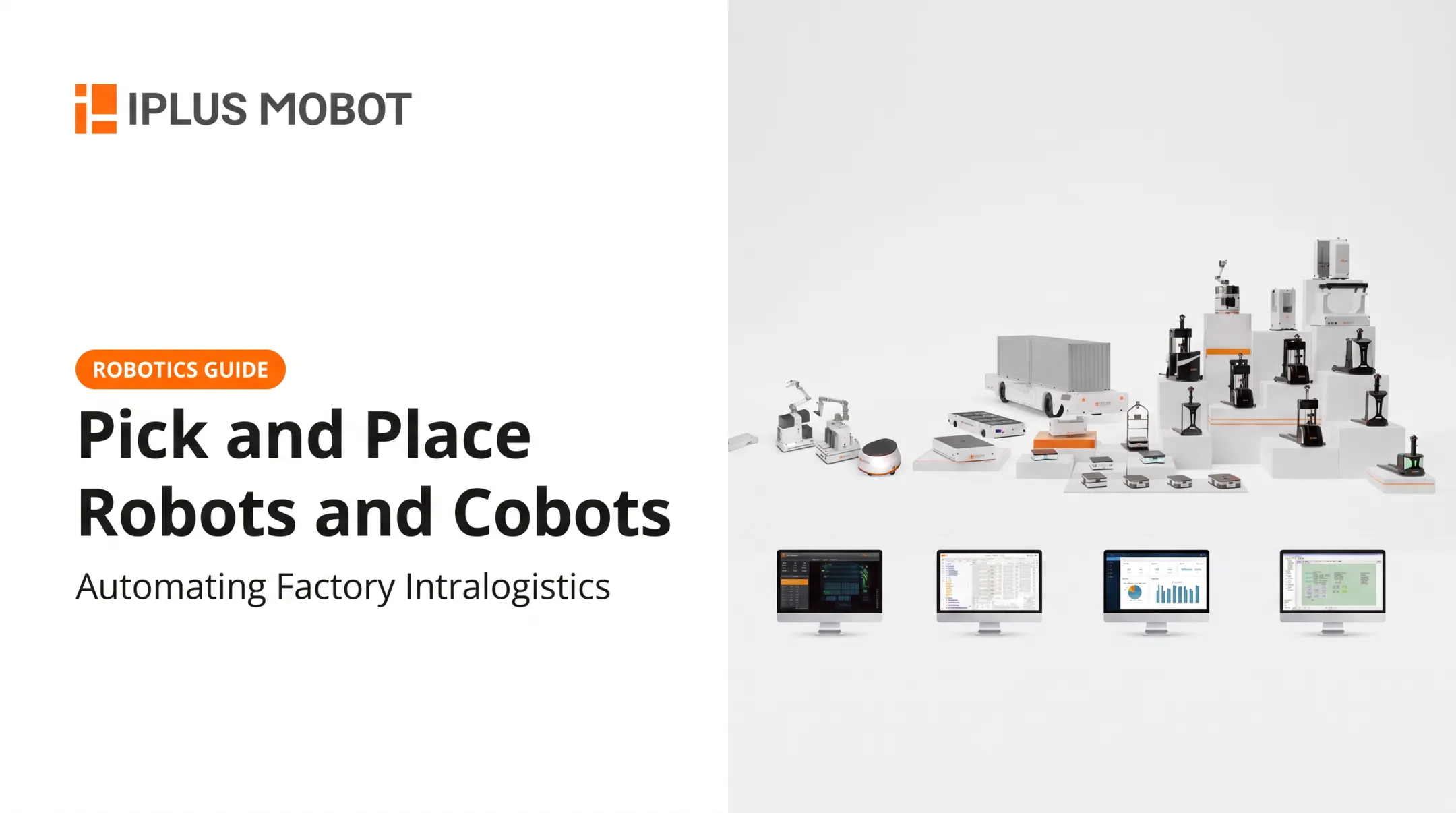
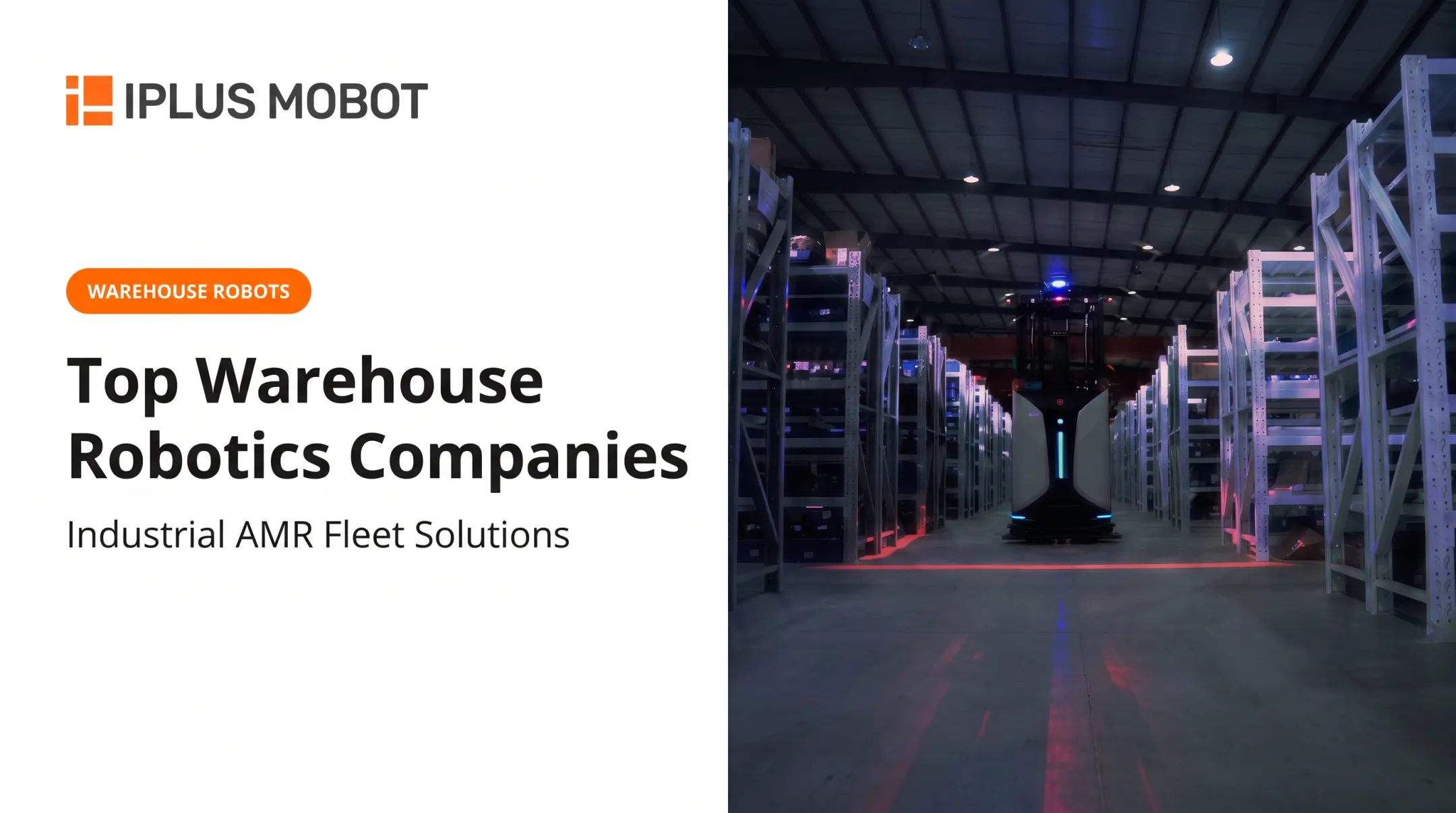
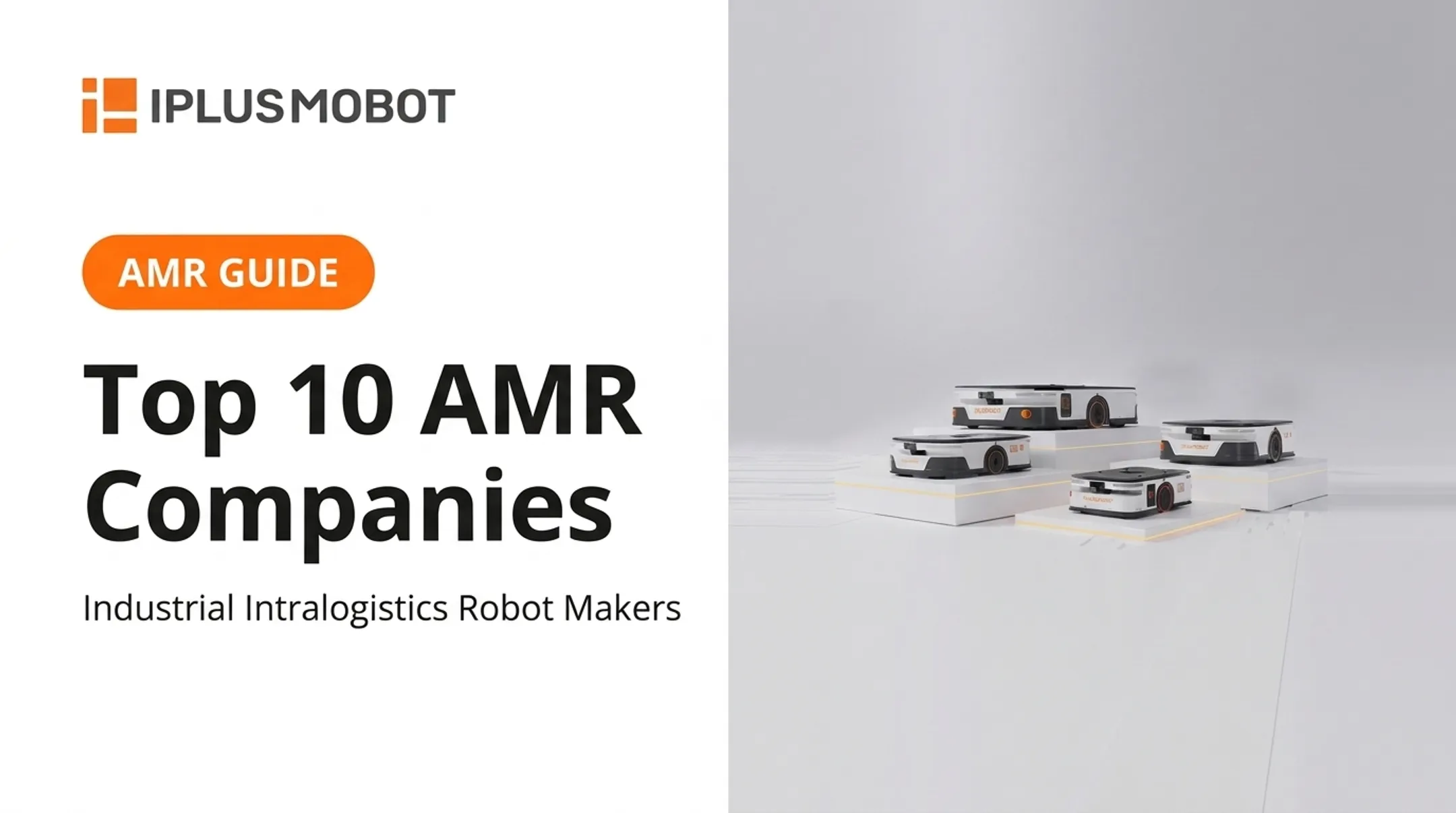
Picking a manufacturer is harder than it looks. A fixed arm suits welding or assembly. AMRs and autonomous forklifts suit line-side delivery, pallet movement and warehouse work.
This shortlist covers IPLUSMOBOT, ABB Robotics, FANUC, KUKA and Yaskawa Motoman. The order reflects relevance and capability, not an independently audited market-share ranking.
Key Takeaways
- Manufacturers now span articulated robots, SCARA, cobots, AMRs, autonomous forklifts, controllers and fleet software.
- Match vendors to payload, reach, navigation, environment, integration, safety and lifecycle cost.
- IPLUSMOBOT covers AMRs, autonomous forklifts and fleet software for intralogistics.
- ABB, FANUC, KUKA and Yaskawa lead for fixed-arm factory automation.
Overview of Industrial Robot Manufacturers in the US Market
An industrial robot manufacturer designs and produces robotic hardware, controllers, navigation systems, software or integrated automation platforms for industrial sites. System integrators then deploy that equipment for end users.
Where US demand comes from
Demand is uneven across sectors. The A3 Q3 2026 report shows North American orders of 10,989 robots, up 24.8%. Semi, electronics and photonics unit orders rose 97.6%. These are orders, not shipments.
IFR data for 2025 US installations:
- Automotive: 13,500, down 1%
- Food and beverage: 2,900, up 30%
- Metal and machinery: 3,000, down 15%

Warehouses and 3PLs are growing too. Interact Analysis forecasts the global mobile-robot market to grow 19% a year through 2030, reaching $14 billion.
Four robot types, quickly
- Fixed industrial robots: reprogrammable manipulators with three or more axes, used for welding, painting, assembly and palletizing.
- Cobots: built to work near people, with force-limited joints and system-level safety requirements.
- AMRs: make real-time navigation decisions, unlike AGVs that follow preset paths.
- Autonomous forklifts: move pallets and loads with little or no operator input.

Top Industrial Robot Manufacturers for US Manufacturers
Compare vendors on application breadth, technical capability, software and controls, safety and quality evidence, integration ecosystem, market presence, lifecycle support and suitability for US buyers. Verify current specifications and support arrangements directly with each manufacturer.
1. IPLUSMOBOT
Founded in 2016 to develop autonomous mobile robots, IPLUSMOBOT now offers AMRs, forklift AMRs, fleet-management software, mobile manipulation platforms and smart intralogistics systems. It has manufacturing in Quzhou, China, and says it works with more than 500 manufacturers.
Strengths center on mobile material handling and flexible production:
- Self-developed core technology, from standalone robots to plant-wide fleets
- Solutions for automotive and EV components, electronics and PCBA, warehouses, 3PLs, outdoor yards and inter-plant transport
- FOLA forklift AMRs, stated to comply with ISO 3691-4:2023
- CLOUDIA fleet management for coordinating hundreds to thousands of robots
In one documented case, more than 100 AMRs ran with CLOUDIA in a clean LCD workshop of nearly 4,000 m², holding ±2 mm/0.2° precision. Market-share, capacity, certification and partnership claims come from company documentation, so confirm them with the company.
| Area | What to know |
|---|---|
| Robot and application scope | EMMA standard AMRs (EMMA K up to 1.5 T) and FOLA forklift AMRs for line-side delivery, pallet movement, put-away and replenishment. BN3001 handles 3,000 kg. MORA cobot AMRs serve semiconductor lines; LUNA covers outdoor, heavy transport. |
| Integration and scalability | CLOUDIA and CARLY manage fleets; customized 3C-electronics AMRs integrate with MES and WMS. Confirm interfaces, APIs and control-system compatibility for your site. |
| Quality and US buying | Company documents list ISO 9001:2005 and CE certification. It reports a US subsidiary established in 2025. Confirm local integration, commissioning, training, maintenance, spare parts and response times. |

IPLUSMOBOT does not make articulated or SCARA robots. For welding or assembly cells, look at the next four.
2. ABB Robotics
ABB offers industrial and collaborative robots, AMRs, controllers (OmniCore) and software such as RobotStudio and AMR Studio Suite. Its Americas headquarters and robotics factory sit in Auburn Hills, Michigan, and ABB University offers onsite and online training.
It suits broad portfolios, multi-industry work and multi-site programs. ABB's Value Provider Program trains and qualifies channel partners. A UL certificate covers specified OmniCore functional-safety models, not every cell.
- Reports more than 500,000 robots shipped (a shipment figure, not installed base)
- Dorman Products reported a 300% rise in daily output in battery remanufacturing (vendor-reported)
- ABB agreed in October 2025 to sell its Robotics division to SoftBank for $5.375 billion; the deal was still subject to approvals as of November 2026
Ask how the pending ownership change affects support and roadmap.
3. FANUC Corporation
FANUC America, based in Rochester Hills, Michigan, offers articulated, delta and SCARA robots plus the CRX collaborative family. Its R-30iB Plus controller, iRVision, ROBOGUIDE simulation and Zero Down Time preventive maintenance round out the stack.
Strengths include high-volume reliability, CNC integration and a large authorized-integrator network. FANUC Academy provides training and certification.
- FANUC America publishes ISO 9001:2015 certificates for listed sites, not for individual robots or cells
- Reached one million robots produced in 2023 (production, not installed base)
- Published cases include JTEKT North America in automotive assembly
Check payload, reach, environmental rating, warranty and local service for the exact model family.
4. KUKA
KUKA offers articulated, SCARA and delta robots, plus AMRs, mobile manipulators and autonomous forklifts. Its KR C5 controller, iiQKA.OS2 operating system and iiQWorks.Sim simulation support engineering and commissioning.
Core fits include automotive, logistics and flexible production. KUKA's US operations include Shelby Township, Michigan, with KUKA College training and a System Partner Program.
Zhongli North America used KUKA for welding and material handling in Michigan, and KUKA's AMP platform has gone live at KTPO in Ohio.
KUKA lists ISO 9001, 14001 and 45001 certificates, but confirm whether scope covers individual robots or cells. Midea Group owns KUKA. Confirm payload and reach ranges, safety functions, warranty and integrator availability.
5. Yaskawa Motoman
Yaskawa Motoman sits within Yaskawa Electric, pairing robots with servos, drives and controllers. Its US catalog includes HC-series cobots and the MPP3S delta robot. Software includes MotoSim, Yaskawa Cockpit, MotoPlus and PalletSolver.
It fits welding, handling, packaging and palletizing where motion control and robot hardware work as one system. The Motoman division is headquartered in Miamisburg, Ohio, with a Detroit Regional Center in Rochester Hills, Michigan. Yaskawa Academy reports more than 75 courses and over 90 training robots.
- Announced 500,000 cumulative MOTOMAN shipments in February 2021
- Cites ISO 9001:2015; confirm certificate scope
- Announced robotic warehouse solutions for North America in February 2026
Verify model specs, safety compliance, spare parts and expansion options.
How We Chose the Best Industrial Robot Manufacturers
Company age, revenue or one market-share figure doesn't settle it. Comparing an AMR provider directly with a fixed-arm supplier, without considering the use case, is the classic mistake.
Application and technical fit
Start with the task: transport, manipulation or both. A mobile base with a manipulator is a different configuration from a transport-only AMR or a fixed cell. Then check:
- Payload, reach, cycle time and accuracy
- Navigation method, floor conditions and load type
- Speed, battery or energy needs
- Compatibility with existing equipment
Safety, quality and integration
Review ANSI/A3 R15.06-2025 and ISO 10218 for robots and cells, ISO/TS 15066 for collaborative operation, and ANSI/A3 R15.08 for mobile robots. ANSI/ITSDF B56.5 covers driverless vehicles. OSHA has no robotics-specific standard but other workplace rules still apply. Also check controls, APIs, vision compatibility and qualified integrators.
Lifecycle value
A3's ROI guidance says to count more than the robot: vision, grippers, barriers, interfaces, transport, integration and maintenance. It gives no universal payback period.
Also compare commissioning, training, spare parts, warranty, software licensing, uptime support and scalability.

Conclusion
The best manufacturer is the one whose hardware, software, support, and integration ecosystem match your operational goals, not necessarily the best-known brand. Before you choose, compare:
- Application fit for your workflows
- Safety documentation and certifications
- Technical specifications
- Support coverage and response times
- Total cost of ownership
If you're planning mobile material handling or smart intralogistics, contact IPLUSMOBOT to discuss AMRs, autonomous forklift robots, fleet software, and deployment for your plant or warehouse.
Frequently Asked Questions
What is an industrial robot manufacturer?
A company that builds industrial robotic hardware, controllers, navigation systems, software or integrated platforms. It differs from a system integrator, who designs and installs cells, and from a component supplier.
Which industrial robot manufacturer is best for US factories?
It depends on the application. Weigh robot type, payload, reach, environment, integration needs, safety, support and lifecycle cost.
What types of industrial robots do manufacturers offer?
Articulated, SCARA and delta robots, cobots, AMRs, autonomous forklifts and mobile manipulators. They also supply controllers and fleet or factory software.
Are autonomous mobile robots considered industrial robots?
When built for manufacturing, warehouse or intralogistics material handling, they are industrial mobile robots. They differ from fixed arms, which manipulate in place.
How should businesses compare industrial robot manufacturers?
Compare application fit, specifications, safety, software, integration support, serviceability, scalability, certifications and total cost of ownership across a full cell or fleet.
What safety and compliance factors should US buyers check?
Review ANSI/A3 R15.06, ISO 10218, R15.08 for mobile robots, OSHA and NFPA 79 requirements, plus risk assessment, guarding and emergency stops. Work with qualified professionals on site-specific compliance.