Introduction
Material movement looks simple until you count the trips. Carts pushed down the same aisle forty times a shift, forklifts jamming at a doorway, a production line waiting on a rack of parts.
Add labor strain and layouts that change every quarter, and the cost of manual transport adds up fast.
Autonomous mobile robot (AMR) solutions target exactly these problems. The Manufacturing Institute and Deloitte projected that U.S. manufacturers could need 3.8 million additional employees between 2024 and 2033.
That is a projection, not a current vacancy count, but it explains the interest in automation.
This guide is for plant managers, warehouse operators, and integrators. It covers the technology, AMR versus AGV, robot types, business value, and a controlled deployment plan.
Key Takeaways
- An AMR solution includes the robot, sensors, navigation, fleet software, charging, interfaces, and processes.
- AMRs navigate changing spaces on their own, but still need safety controls and human oversight.
- Payload, distance, traffic, floors, throughput, and WMS/MES/ERP links decide the right fit.
- Pilot one measurable workflow before scaling.
What Are Autonomous Mobile Robot (AMR) Solutions?
AMR stands for autonomous mobile robot. Three related terms often get mixed together:
- Mobile robot: ISO 8373 defines it as a robot able to travel under its own control. It is a broad term.
- AMR platform: the vehicle plus its navigation and attachments.
- AMR solution: the platform plus everything needed to finish a workflow.
A typical solution stack includes:
- Chassis, drive system, and lifting or conveyor mechanism
- Sensors, localization, and navigation software
- Fleet manager and operator interfaces
- Charging equipment and a reliable wireless network
- Integration with facility automation and business systems
AGV versus AMR: choosing the right movement model
Traditional AGVs follow fixed paths using tape, magnets, or wires. AMRs use software-defined navigation and pick routes dynamically. Not every AGV needs floor infrastructure, and the better fit is application-specific.
AGVs still work for highly stable, repetitive routes with no foreseeable reconfiguration. AMRs fit mixed-traffic aisles, blocked routes, changing production cells, and seasonal demand, because rerouting happens in software rather than through physical path changes.
What tasks can an AMR perform?
- Material transport and line-side replenishment
- Work-in-process movement between production and storage
- Pallet handling and cart or trailer towing
- Warehouse replenishment and goods transfer
Lifting, towing, and manipulation depend on the chosen robot and attachments. A standalone deployment simply moves loads. An integrated workflow exchanges jobs and status with conveyors, lifts, WMS, MES, ERP, or PLC controls.
When is an AMR a strong fit?
Look for frequent repetitive transport, mixed human and vehicle traffic, changing routes, or a measurable bottleneck. AMRs also suit teams that want to scale automation in stages.
Flag constraints early:
- Very uneven floors, rocks, bumps, or lift gaps that can trap robots in brownfield facilities
- Extreme temperatures or hazardous areas
- Weak network coverage
- Unstructured outdoor terrain
- Unclear load and destination rules
IPLUSMOBOT's documentation notes these floor conditions are a common brownfield risk to assess up front.
How Do AMR Solutions Work?
Sensors and perception
Sensor packages vary by model. Common elements include LiDAR, cameras, encoders, IMUs, proximity sensors, and bumpers. Some robots add 3D cameras or radar. That perception data drives localization, speed adjustment, obstacle response, and status reporting.
Mapping, localization, and route planning
SLAM (simultaneous localization and mapping) lets the robot build a map while locating itself on that map. Operators typically drive a vehicle around the site once to create the scan. Maps can also mark no-go zones, such as pedestrian walkways.
A simple mission flow:
- The system receives a replenishment order.
- An AMR leaves storage for the production cell.
- It finds an aisle blocked and reroutes.
- It docks, hands off the load, and confirms delivery.

Fleet management and orchestration
Fleet software assigns jobs, balances workloads, manages traffic, prioritizes urgent missions, and schedules charging. Some platforms, such as OTTO's fleet manager, assign jobs by battery level and utilization. Dashboards, alarms, and mission history give operators and maintenance teams real-time visibility.
IPLUSMOBOT's CLOUDIA provides task tracking, traffic control, remote anomaly alerts, and statistical reports.
Integration with operational systems
APIs, industrial interfaces, and middleware connect AMRs to WMS, MES, ERP, conveyors, elevators, and automatic doors. Information flows both ways. Upstream systems create and prioritize jobs. The AMR returns status, location, exceptions, and completion data.
Protocols differ by vendor. VDA 5050 standardizes robot-to-fleet-control communication but is not a safety standard.
Safety, charging, and human oversight
Day-to-day operation still depends on layered safety controls and clear exception handling:
- Speed zoning, obstacle detection, and emergency stops
- Safe handoffs and pedestrian interaction rules
- Battery management and charging strategy
- Procedures for blocked routes or failed missions
U.S. requirements depend on the equipment and application. Relevant references include ANSI/A3 R15.08, ISO 3691-4, UL 3100, and OSHA's General Duty Clause. Consensus standards are not OSHA regulations. Ask suppliers for model-specific documentation, and do not assume compliance without it.
Types and Applications of AMR Solutions
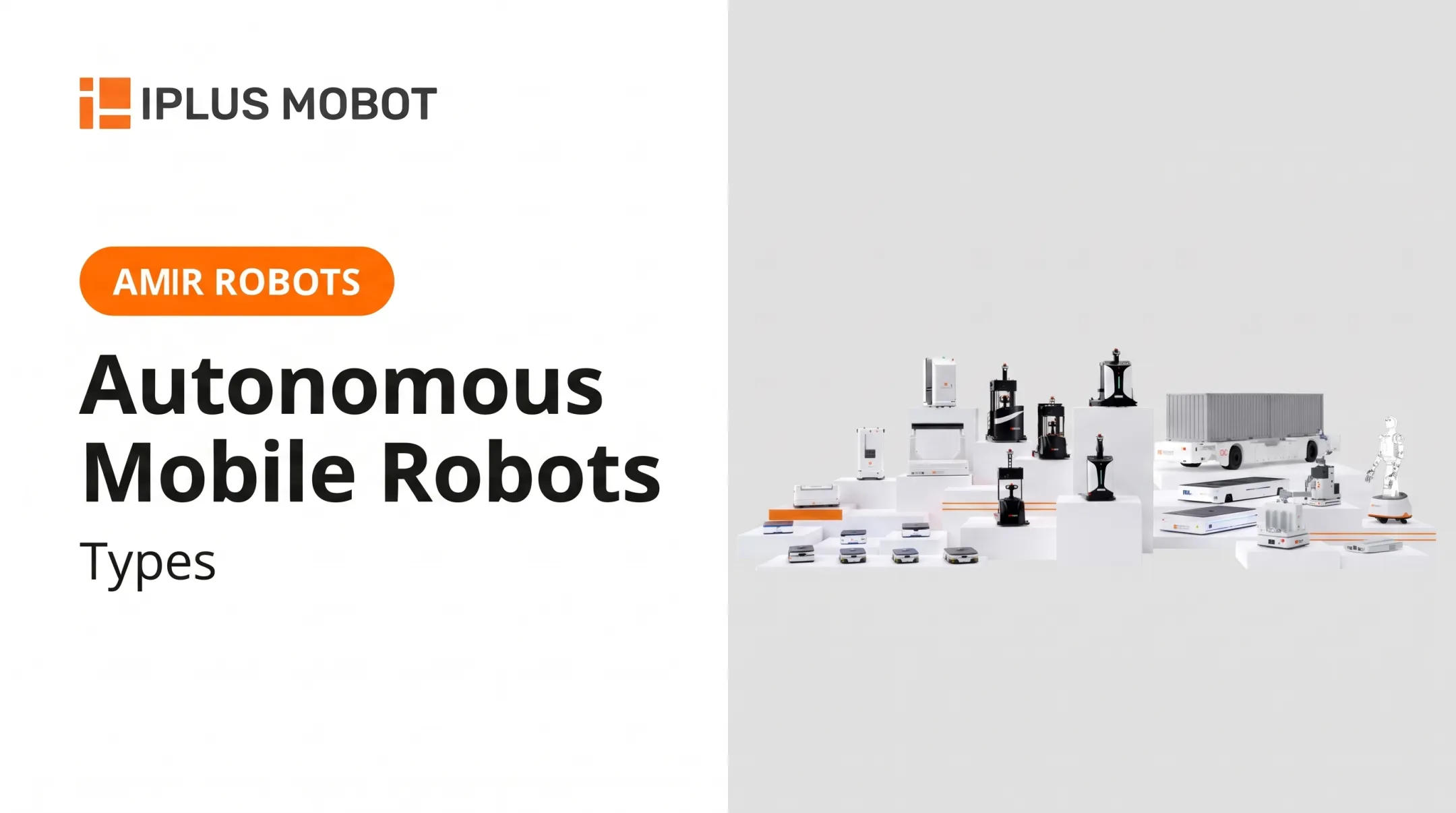
Robot types by payload and movement
| Type | Typical use |
|---|---|
| Conveyor or cart AMRs | Machine and line docking |
| Towing robots | Cart trains, milk runs |
| Pallet and forklift AMRs | Put-away, high-bay stacking |
| Under-riding robots | Racks and carts lifted from below |
| Omnidirectional platforms | Tight spaces, large loads |
| Heavy-duty outdoor robots | Yards, inter-plant transport |
| Mobile manipulators | Machine tending, wafer handling |
Load size, weight, center of gravity, lifting height, turning radius, docking precision, and floor surface pick the platform more reliably than a category label.
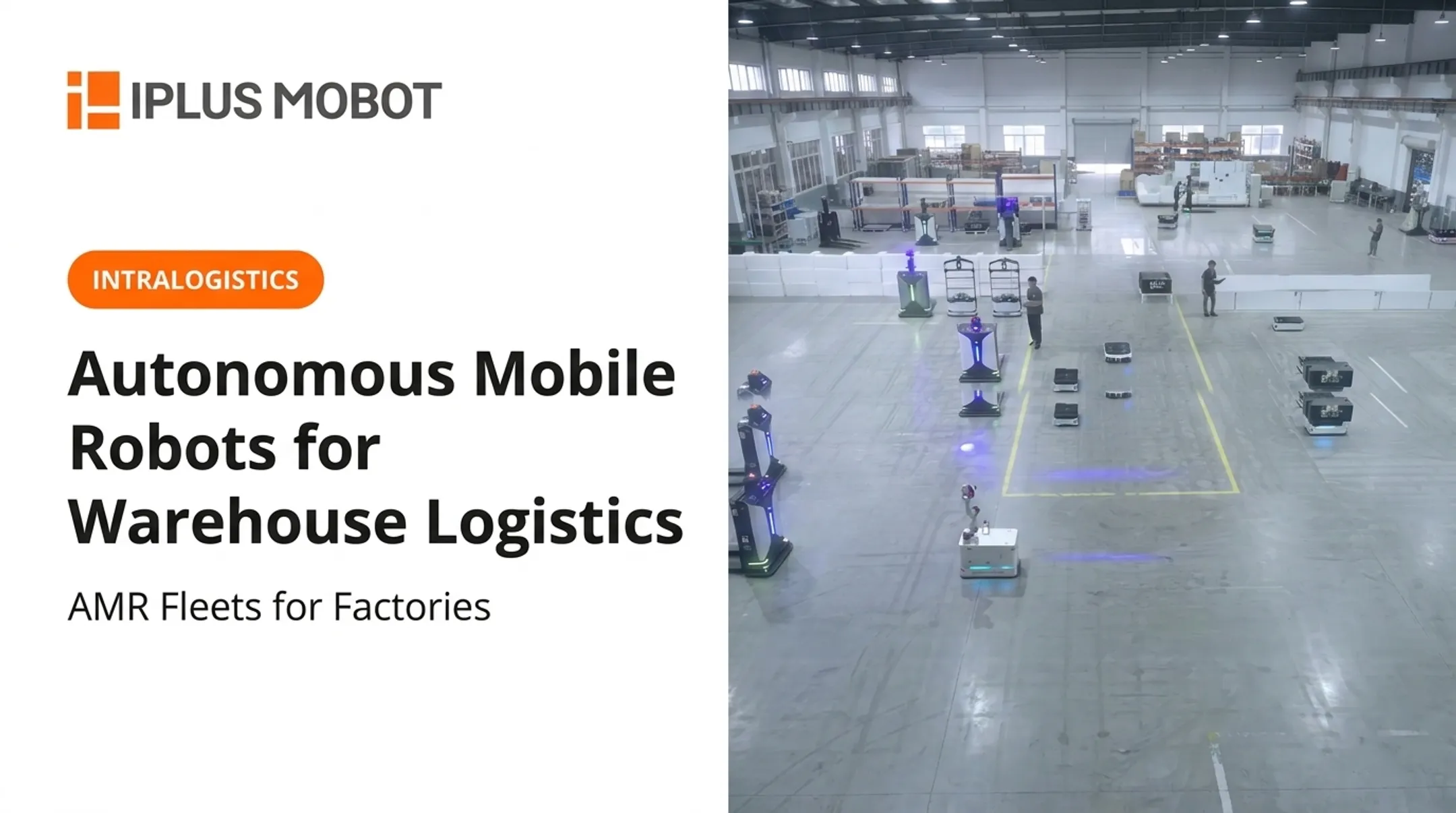
Manufacturing, electronics, and new energy
Published deployments illustrate the factory work AMRs handle:
- OMRON's Polar Semiconductor case used seven AMRs to move material from central storage to production
- Another OMRON case has AMRs replenishing SMT component reels
- A ForwardX release describes BYD using AMRs and autonomous forklifts in battery production
These are vendor cases, not independent studies.
Special requirements in these environments often include:
- Fragile, high-value parts
- Controlled or cleanroom areas
- Just-in-time replenishment
- Multi-shift operation
IPLUSMOBOT offers customized AMRs for LCD, SMT, and lithium-battery work. Its battery-factory documentation covers mixed human-vehicle traffic, narrow aisles, air-shower doors, and lifts.
Warehousing, 3PL, and outdoor use
Warehouse uses include pallet put-away, replenishment, staging, and goods-to-person support. Outdoor yards add weather, terrain, visibility, and load protection. Many indoor AMRs are not rated for outdoor use: MiR's manual restricts the MiR600 to indoor industrial settings.
| Application | Match on |
|---|---|
| Pallet put-away | Payload, lift height, aisle width |
| Line-side delivery | Docking accuracy, traffic, MES link |
| Cleanroom WIP | Cleanliness, precision, handoff gear |
| Outdoor yard | Environmental rating, terrain, navigation |
Benefits and Considerations of AMR Solutions
Operational and workforce benefits
AMRs can:
- Cut non-value-added travel
- Keep material available
- Reduce repetitive lifting
- Free employees for quality and problem-solving work
In a Locus case, GEODIS Dallas reported 65 to 98 units per hour with 12 robots and less heavy-cart pushing. MiR reports Forvia payback under two years. Both are site-specific vendor claims, not benchmarks. Savings and ROI vary with the operation.

Implementation challenges
- Integration complexity and network reliability
- Floor quality and facility readiness
- Operator adoption, training, and clear escalation paths
- Maintenance, spare parts, and software updates
- Cybersecurity (IEC 62443 splits duties among owners, integrators, and vendors)
- Recovery when a robot or handoff point is down
Automation changes roles. Plan training and human-machine interaction from the start.
Building a credible business case
Total cost of ownership includes:
- Robots and attachments
- Fleet software and integration
- Charging and infrastructure changes
- Training, support, and maintenance
- Downtime and expansion
Small fleets may not need full fleet management or ERP integration, and each choice shifts cost.
Measure a baseline first, then track pilot KPIs:
- Transport cycle time and completed missions
- Intervention frequency and uptime
- Utilization and delivery accuracy
- Forklift travel and safety observations
How to Choose and Deploy an AMR Solution
Start with a workflow and facility assessment
Document the facility and material-flow details that shape robot fit:
- Origins, destinations, distances, and frequency
- Load types, weights, and dimensions
- Shifts, congestion, and pedestrian traffic
- Doors, lifts, charging spots, floors, and environment
Then rank candidate workflows by:
- Repetition and bottleneck impact
- Process stability and safety exposure
- Integration readiness and manual travel saved
Evaluate the supplier, platform, and integration model
Check:
- Navigation performance and fleet features
- Open interfaces and interoperability
- Diagnostics and cybersecurity practices
- Model-specific safety documentation
- Training, spare parts, remote support, and roadmap
- References and testing support
Settle roles early under the ANSI/A3 R15.08 framework:
- OEM: robot design
- Integrator: application and fleet adaptation
- Customer: use, risk, and change management
Agree who owns mapping, integration, acceptance testing, training, and post-launch support.
Pilot before scaling
Pick one measurable workflow with acceptance criteria set before the trial. Use representative loads, normal traffic, and realistic exceptions. Test:
- Obstacle response and docking accuracy
- Handoff reliability
- Network interruptions and charging behavior
- Recovery from blocked routes
- Human interaction and system integration
Roll out in controlled stages
- Solution design and site preparation
- Mapping and interface development
- Offline testing and safety review
- Commissioning and operator training
- Go-live monitoring and performance review
- Phased fleet expansion
Feed lessons back into SOPs, maintenance plans, fleet rules, and traffic controls.

Where IPLUSMOBOT can fit
IPLUSMOBOT, founded in 2016, builds AMRs, CLOUDIA and CARLY fleet software, and warehouse software for manufacturers, warehouses, and automation integrators.
Its range runs from standalone robots to plant-wide deployments, with lines for standard, forklift, omnidirectional, outdoor, and mobile manipulation use. It also has US and Japanese subsidiaries.
Its five-part lifecycle service covers:
- Proposal and simulation
- Application design
- Onsite support
- Operations and maintenance
- Software upgrades
Verify current specifications for any model, such as EMMA, OMNI, MORA, or FOLA, before you plan around it.
Integrators and operators can send workflow, payload, facility, and integration requirements to sales@iplusmobot.com.
Conclusion
An AMR solution combines autonomous mobility, fleet intelligence, software integration, safety planning, and change management. Buying a robot is only one piece.
Start with one material-flow problem. Set a baseline, assess facility and system needs, and compare suppliers on deployment fit, support, interoperability, and scalability.
Frequently Asked Questions
What is an AMR solution used for?
It automates material movement, replenishment, pallet transport, work-in-process delivery, and warehouse transfers. These are repetitive intralogistics tasks in factories and warehouses.
What are the components of an AMR solution?
Mobile platforms, towing or forklift robots, conveyor and cart systems, or mobile manipulators. Fleet software, charging, and integrations with warehouse or manufacturing systems complete the package.
What is AMR an acronym for?
Autonomous mobile robot. It uses onboard sensing and navigation software to move through changing environments without fixed guide paths.
How do AMR solutions work in a warehouse or factory?
Robots sense surroundings, localize on a map, plan routes, and respond to obstacles. Fleet software dispatches jobs and charging, and connects with WMS, WES, MES, or equipment.
How do I choose an AMR solution for my operation?
Compare payload, route, environment, traffic, throughput, handoffs, integration, safety documentation, and support. Validate with a pilot and a total-cost-of-ownership estimate.